Me
Guowei (Peter) Lu — graphics researcher, engineer, runner, and curious traveller.
A personal introduction · Guowei / Peter
I imagine things.
I try to understand them.
Then I build.
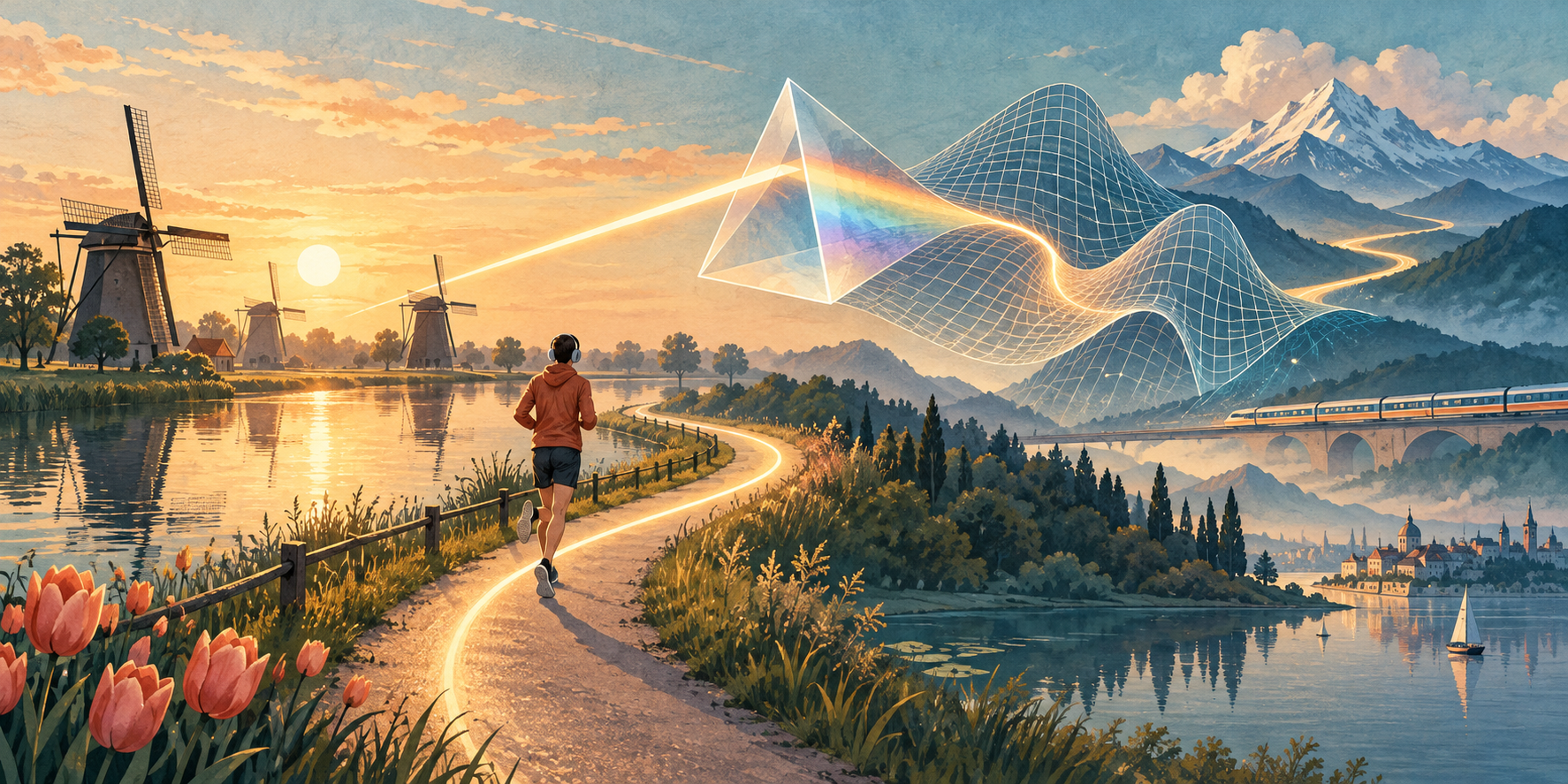
Light, geometry, code, music, and the world outside the screen.
In a few words
I’m Guowei Lu, also known as Peter. I work in computer graphics, with a background in research and 3D GIS engineering. I’m drawn to the meeting point of mathematics, code, and images: how light behaves, how surfaces are represented, and how an idea becomes something we can see.
Outside that work, I run while listening to music and make room for travel and family. I want to understand difficult things deeply, build things that are useful, and keep enough curiosity for the world beyond my work.
The longer story
Light, geometry, and making ideas visible
My academic path brought me to Utrecht University, where I completed an MSc with honours in Computer Science, in the Game and Media Technology programme, in summer 2020. In June 2022, I joined the Computer Graphics and Visualization group at TU Delft as a PhD candidate.
My research interests include real-time rendering, realistic materials, global illumination, and virtual reality. Differentiable and neural rendering are also areas I want to understand better. A recurring question behind these interests is how to make a convincing image while respecting the practical limits of computation.
My professional background also includes working in SuperMap’s R&D department as a 3D GIS engineer, on virtual-earth and mapping products. That experience gives a practical dimension to my interest in graphics: images and spatial models can help people explore and understand real places.
What I contribute
Research is collaborative. Two milestones in my work with colleagues are Sheared Polygonal Texture Filtering, presented at Graphics Interface 2024, and Iterative Lightmap Update for Scene Editing, accepted to Pacific Graphics 2025.
The texture-filtering work explores how to filter textures accurately over quadrilateral footprints while keeping computation efficient. Its applications include normal filtering, soft shadow mapping, and glint rendering. Our paper received the Best Computer Graphics Student Paper award at GI 2024. I value this as a concrete result of careful work with other people.
My learning has also taken me through discrete differential geometry, exterior calculus, rendering, 3D GIS, and explainable AI. I have explored these subjects through technical notes, using explanation as a way to check my own understanding. That work is part of my background, even as this website now focuses on my research and personal story.
For the formal record, see my publications and CV.
The abilities I keep developing
My work sits across several kinds of thinking: mathematical reasoning, implementation, visual judgement, and explanation. I enjoy the process of moving between them. A mathematical expression can become an algorithm; an image can reveal a problem in that algorithm; writing can expose something I have not yet understood.
I also like connections that reach outside the immediate technical task. Ideas about dimensions, frequency, and representation have given me ways to think about music, emotion, and difficult questions. Those connections are ways to explore rather than proofs that everything has a mathematical answer.
I want to keep improving my foundations in mathematics, physics, and optimisation. I’m interested in AI as something that can become useful in a real workflow: a tool that helps people learn, create, or solve a problem. There is plenty I still want to learn.
Running, music, and a different rhythm
“I imagine things and render. I listen to music while running.” That small line on my homepage captures two sides of me surprisingly well.
Running and music belong together in my life. Music also gives me a way to recognise feelings that are difficult to explain directly. I wonder whether a song can translate something complicated inside us into a form we can hear and share.
I want room for reading beyond technical subjects, too. Books I have wanted to explore include Other Rivers, A Brief History of Intelligence, and A Biography of the Pixel. They are reading interests, not a list of books I claim to have finished.
Travel: curiosity outside the screen
Travel is part of my life beyond research. Over three summers, my journeys have taken me from Delft through cities in central Europe, into the Swiss Alps and Italy, and north to Scandinavia. Trains connect much of this story: a trip becomes a sequence of places rather than a single destination.
2024 · A summer through central Europe
In August 2024, I travelled from Delft to Hamburg, Berlin, Dresden, Prague, Vienna, Salzburg, and Cologne, before returning to Delft. The journey connected Germany, Czechia, and Austria over a little more than two weeks.
The route: Delft → Hamburg → Berlin → Dresden → Prague → Vienna → Salzburg → Cologne → Delft.
2025 · From Disneyland to the Alps and Italy
In August 2025, my journey began with Disneyland Paris, then continued through Lyon, Geneva, Lausanne, and Montreux. From Montreux, the route followed the GoldenPass to Interlaken, then continued to Grindelwald in the Swiss Alps.
The second half took me through Milan, Venice, Florence, and Pisa, ending in Rome and Vatican City before a flight back to Amsterdam. This trip brought very different settings into one journey: a theme park, lakes and mountains, and Italian cities.
The route: Delft → Disneyland Paris → Lyon → Geneva → Lausanne → Montreux → Interlaken → Grindelwald → Milan → Venice → Florence → Pisa → Rome and Vatican City → Amsterdam.
2026 · Central Europe, then north
In July and August 2026, I travelled from Delft through Düsseldorf, Munich, Bratislava, and Budapest, including a day trip to Garmisch-Partenkirchen. From Budapest, the journey turned north to Bergen, Oslo, Stockholm, and Copenhagen, before returning to Delft.
The route: Delft → Düsseldorf → Munich, with Garmisch-Partenkirchen → Bratislava → Budapest → Bergen → Oslo → Stockholm → Copenhagen → Delft.
These routes tell you where I have been. I also want this space to hold what I remember: a place, a conversation, an unexpected moment, or a photograph with a story behind it. Those details will make the travel story more personal than a list of stops.
My travel map
The countries in my 2024–2026 travel history, including the Netherlands as my starting point. Belgium is shown separately as a transit stop. Choose a year, then select a highlighted country or its name to explore the destinations.
Loading travel history…
Visited Transit · Small countries use location markers.
Select a country to see its destinations.
Country outlines: Natural Earth, public domain. Overview boundaries are simplified.
Photo gallery
My photographs from Venice, Grindelwald, and Montreux bring a few moments from my 2025 journey into this page. The gallery also includes credited destination reference images, labelled separately. Select a photo to open the full image.
A life with room for other people
I want a better balance between work and life, and more time for my child’s education. That matters to the picture of who I am. Research takes a lot of attention, but so do the people and experiences I want to be present for.
I care about useful work, learning, and creativity. I also want a life in which travel, running, music, reading, and family are given real time. This page is a way of keeping those priorities visible alongside academic milestones.
How Codex sees me
What I hope you remember: I care about understanding, making, and sharing—and about staying curious enough to keep growing outside my work.